
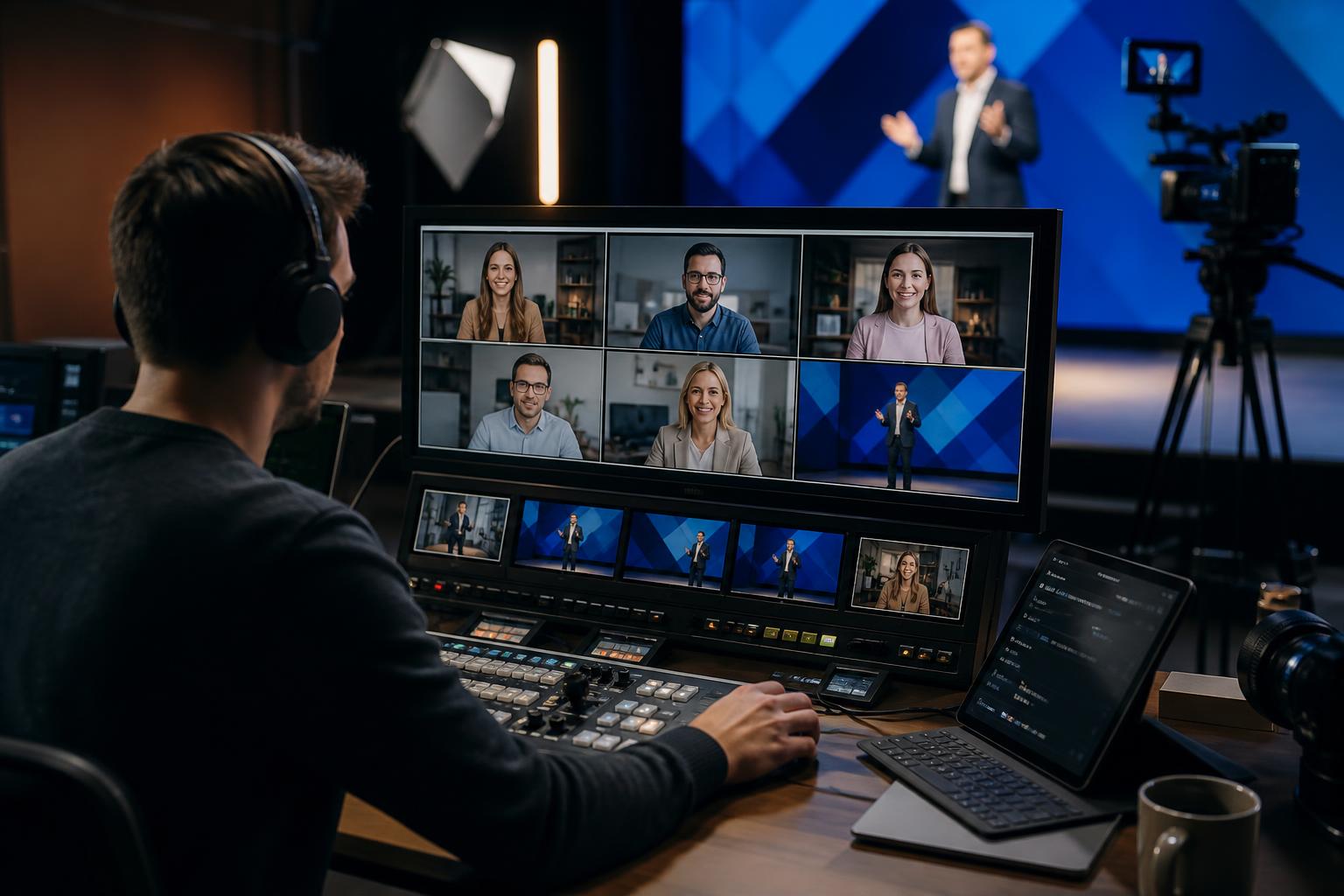
Remote webinar production has shifted from a “nice to have” to a core communications capability. As teams, customers and stakeholders have become more distributed, organisations are relying on live online events to share updates, launch products, train people and build trust at scale. What has changed most is not simply that webinars are happening more often, but that expectations have risen: audiences now judge online events by the same standards they apply to broadcast-quality content.
It is transforming business communication by making it faster, more inclusive and more measurable. A well-produced remote webinar can bring together presenters from multiple locations, connect with audiences across time zones, and deliver a consistent message without the cost and complexity of physical events. It also creates a repeatable format that communications teams can refine, standardise and improve over time.
From “talking heads” to structured, story-led broadcasts. The biggest leap forward is the move away from single-camera, single-speaker meetings towards a planned programme with pace and variety. Remote production enables live mixing of multiple Zoom feeds, the addition of titles and speaker identifiers, lower-thirds, branded frames, and on-screen prompts that keep viewers oriented. When combined with slides, pre-recorded segments and live demos, webinars become closer to a studio show than a conference call, which makes it easier for audiences to follow and remember key points.
Consistency and brand confidence, even with distributed presenters. In many organisations, the challenge is not finding subject matter experts, but presenting them in a way that feels coherent and professional. Remote production helps standardise the experience: consistent visual identity, clear audio, reliable transitions between speakers, and a predictable running order. This reduces the risk of distracting technical issues and helps the audience focus on the message rather than the mechanics.
Greater reach without compromising engagement. Remote webinars remove geographic barriers, but reach alone is not the goal. Modern production techniques support interaction that feels purposeful rather than gimmicky: moderated Q&A, polls that shape the direction of discussion, chat prompts that gather real-world feedback, and on-screen calls to action that guide next steps. When interactivity is planned and integrated into the flow of the event, it strengthens two-way communication and provides insight into what the audience actually cares about.
Better accessibility and inclusion by design. Remote webinar production makes it easier to build inclusive experiences into the live event. Clear captioning, readable slide layouts, strong contrast and thoughtful pacing all improve accessibility. So does giving speakers a structured format and support so they can deliver confidently. For internal communications, this can be particularly powerful: employees who might not attend an in-person event can participate from anywhere, and recordings can be made available for those who cannot join live.
More resilient communications in a world where plans change. Business communication often needs to happen quickly: a leadership update, a regulatory announcement, a crisis response or a time-sensitive product change. Remote production supports agility because contributors can join from wherever they are, pre-recorded elements can be prepared in advance, and contingency plans can be built into the running order. If a speaker drops out or a connection becomes unstable, the programme can continue with alternative content, a host segment, or a switch to another contributor.
Data-led improvement and clearer return on effort. Unlike many in-person events, webinars can produce detailed performance data: attendance, drop-off points, replay views, engagement rates, poll responses and Q&A themes. When combined with a production approach that treats the webinar as a repeatable format, these insights help organisations improve each event. You can learn what length works best, which segments hold attention, and how different audiences respond to different messages, then adjust future communications accordingly.
Hybrid-ready content that lives beyond the live moment. Remote webinar production also changes how content is reused. A live webcast can be recorded, edited into shorter clips, repurposed for internal updates, social channels, training libraries or customer onboarding. With the right planning, a single webinar can yield multiple assets: highlight reels, speaker soundbites, chaptered recordings, and short explainers that extend the value of the original event.
What this means for organisations today. As audiences become more selective with their time, the quality of delivery increasingly influences how messages are received. Remote webinar production is not about adding polish for its own sake; it is about clarity, reliability and audience experience. When the delivery is smooth, the message lands. When the structure is strong, the audience stays with you. When the event is interactive and well-paced, communication becomes a conversation rather than a broadcast.
If you want to raise the standard of your live online events, it starts with production that supports your message. Find out more about Enbecom Studios’ live remote webcasting and video services, including bringing in live Zoom feeds, mixing speakers, slides, captions, pre-recorded video and interactivity, then streaming to multiple platforms: https://enbecom.tv.