
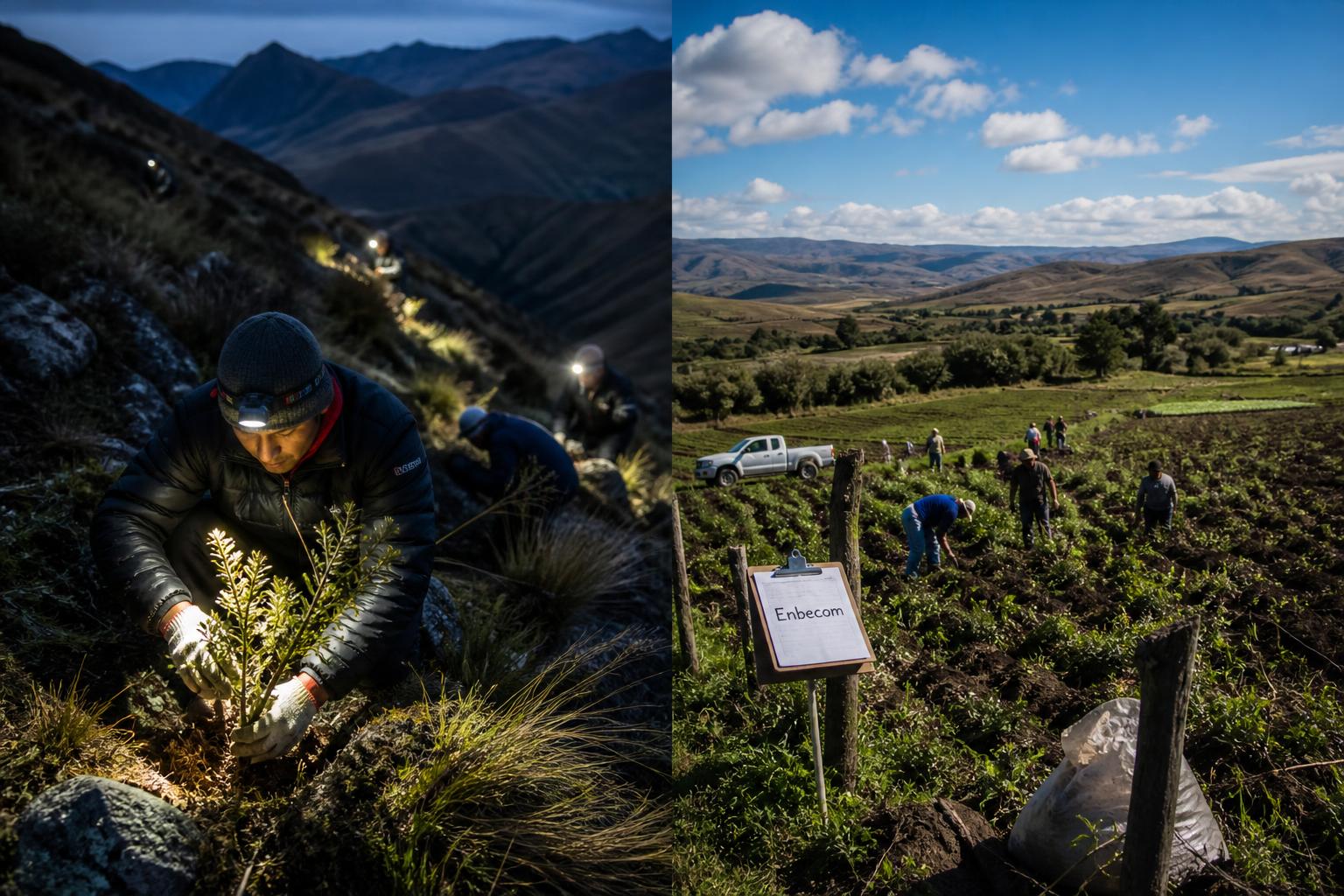
October 2026 is a great moment to reflect on the real-world impact our customers help make possible. Through our ongoing support of environmental projects around the world with our eco-project partner Ecologi, we’re spotlighting two initiatives this month: project 1, restoring native Polylepis forests in the high Andes, and project 2, regenerating agricultural land to remove carbon.
Project 1: restoring native Polylepis forests in the high Andes
High in the Andes, Polylepis woodlands are some of the world’s highest-altitude forests and a vital refuge for unique wildlife. These forests also play an important role in local water cycles by helping to regulate runoff and improve soil stability on steep slopes, which can reduce erosion and support healthier catchments.
What makes this project particularly effective is its focus on native ecology. On average, between 65 and 90% of the trees planted will be locally prevalent species of Polylepis, with other native species included depending on the region. Planting locally appropriate species improves survival rates, strengthens biodiversity, and helps restored areas develop into resilient forest ecosystems rather than monocultures.
Over time, well-established native woodland can support a richer mix of plant life, insects, birds, and mammals, while also contributing to longer-term carbon storage. Projects like this are a reminder that climate action and biodiversity protection often go hand in hand, especially when restoration is rooted in local knowledge and natural habitat recovery.
Project 2: regenerating agricultural land to remove carbon
Regenerative agriculture is more than just an agricultural technique; it is a holistic approach to farming that emphasises the restoration of soil health and the rejuvenation of ecological systems. Healthy soils are one of the planet’s largest carbon stores, and when managed well they can capture and hold more carbon while supporting productive, resilient farms.
This kind of land regeneration typically focuses on improving soil structure and organic matter through practices that work with nature, such as keeping soil covered, increasing plant diversity, and reducing disturbance. The benefits can extend beyond carbon removal: better water retention, reduced erosion, improved biodiversity, and stronger resilience to extreme weather.
By supporting regenerative approaches, we’re helping to back a practical pathway for climate progress that also strengthens food systems and rural livelihoods. It’s a long-term investment in healthier landscapes, where the gains are measured not only in carbon but also in ecological recovery and farm sustainability.
We’re proud to have funded the planting of 4833 trees since the start of our partnership with Ecologi over 5 years.
If you’d like your webinars, webcasts, and video content to support meaningful environmental action, explore our webcasting and video services and see how smart production choices can add up. You can also view our ongoing impact and the projects we support on our online environmental profile.